
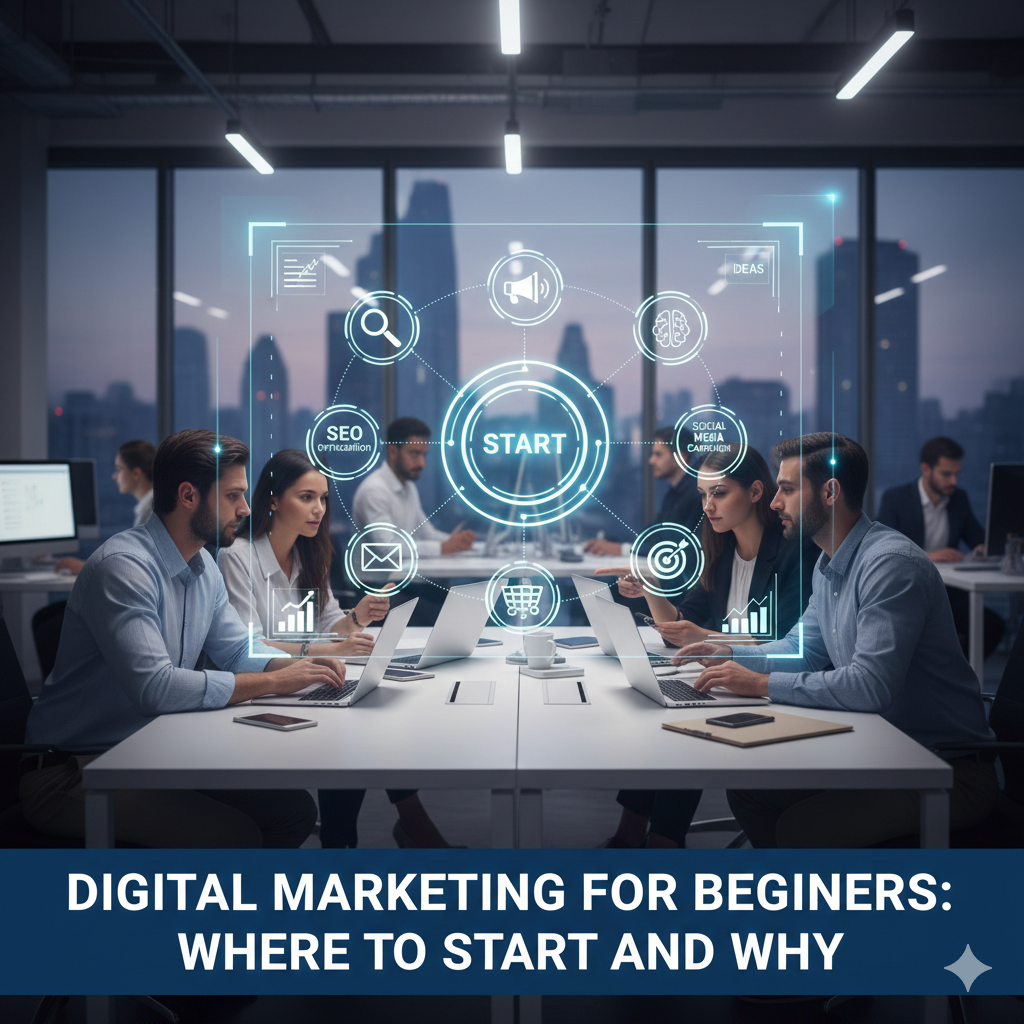
Digital Marketing for Beginners: Where to Start and Why
Digital marketing for beginners starts with understanding one real audience problem and choosing a single channel to solve it—before adding tools or tactics. This approach reduces confusion, saves money, and builds results that actually compound over time.
Why this matters now
Beginners today face more platforms, tools, and opinions than ever. The result is paralysis—doing a little of everything and seeing nothing work. The goal here is clarity: what to learn first, what to postpone, and how to avoid the mistakes that slow most people down.
A beginner-safe starting framework (simple, not simplistic)
Step 1: Pick one audience problem
Forget platforms for a moment. Write down the one question your audience asks repeatedly. That question becomes your compass.
Step 2: Choose one primary channel
Search if people already look for answers
Social if discovery matters more than intent
Email if you already have attention
Step 3: Create one useful asset
A guide, explainer video, or checklist—something that answers the question clearly and completely.
[Pro-Tip] From real usage, beginners who master one channel first grow faster than those juggling four.
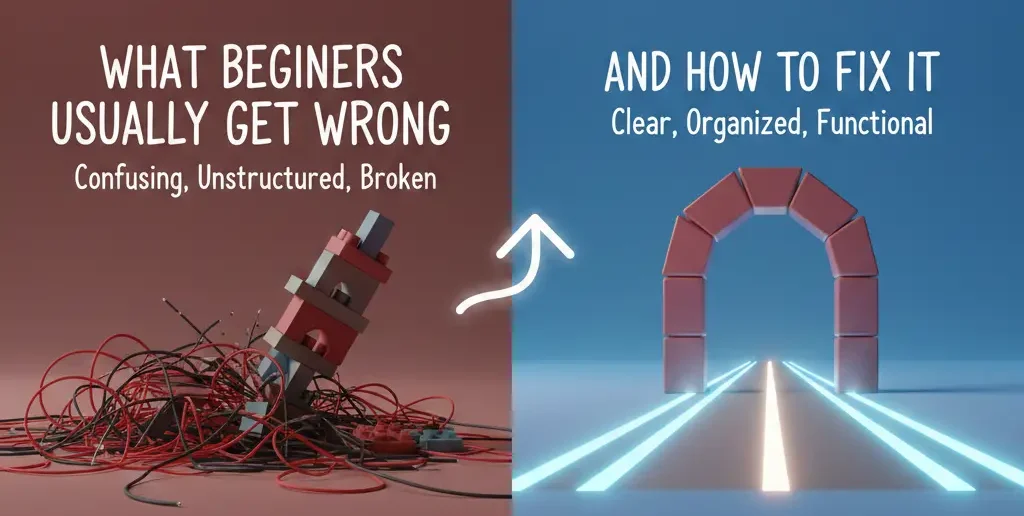
What beginners usually get wrong (and how to fix it)
Mistake 1: Copying advanced strategies
Seeing complex funnels and automation can be inspiring—but copying them too early creates friction.
Fix: Start manual. Learn what resonates before automating.
Mistake 2: Tool overload
Subscribing to multiple tools feels productive but creates noise.
Fix: Use free or basic tools until you know why you need more.
Mistake 3: Expecting instant traction everywhere
Some channels compound slowly.
Fix: Pair a fast-feedback channel with a long-term one.
[Expert Warning] If you don’t know what success looks like for your first 30 days, you’ll keep changing direction—and reset progress.
A practical table: beginner priorities vs. distractions
| Focus First | Why It Helps | Ignore For Now |
| Audience problem | Keeps messaging relevant | Platform hopping |
| One channel | Builds depth | “Omnichannel” claims |
| Clear content | Earns trust | Viral hacks |
| Simple metrics | Shows progress | Vanity numbers |
Information Gain: the overlooked beginner advantage
Most guides push “scale” early. What they miss is that beginners can win by being clearer than everyone else. In practical situations, simple explanations outperform polished ones—because they match how real people think and search.
A beginner mistake most people make (unique insight)
Beginners often try to sound professional instead of being helpful. This creates jargon-heavy content that doesn’t convert. Writing like you explain things to a friend often works better.
[Money-Saving Recommendation] Delay paid ads until you can explain your offer in one sentence that strangers understand.
How to measure progress without stress
Are people reading or watching to the end?
Do they ask follow-up questions?
Are inquiries becoming more specific?
If yes, you’re moving in the right direction.
Learn visually (recommended watch)
YouTube: https://www.youtube.com/watch?v=nU-IIXBWlS4
A beginner-friendly walkthrough of digital marketing basics and channel selection.
Image & infographic suggestions (1200×628 px)
Hero visual: “Beginner roadmap: problem → channel → content”
Alt text: Digital marketing beginner roadmap showing steps from problem to channel
Infographic: “Beginner focus vs. distraction table”
Alt text: Beginner digital marketing priorities compared with common distractions
FAQs (schema-ready)
Do beginners need a website first?
Not always. Start where your audience already is; add a site when needed.
Is social media required?
No. It’s one option, not a rule.
How long before results appear?
Fast channels show signals in weeks; compounding channels take months.
Can I learn without paid courses?
Yes—if you practice consistently and reflect on results.
What’s the safest first channel?
Search or content often offers clearer intent and learning signals.
Internal linking plan
core digital marketing concept → What Is Digital Marketing? A Clear, Real-World Explanation
simple SEO explanation → What Is SEO in Simple Words?
Conclusion
Digital marketing doesn’t reward complexity—it rewards focus. Start with one audience problem, one channel, and one useful asset. Learn from real signals, not noise. Once clarity sets in, scaling becomes natural instead of stressful.
Publishing checklist (quick)
Read-aloud test passed
Featured-snippet answer in first 40 words
Images sized 1200×628 px with descriptive alt text
Contextual internal links added
Say “Continue” to generate Post 3 of Category 1.
Article 2 — Category 1: Digital Marketing
Post: Digital Marketing for Beginners: Where to Start and Why
Meta Title (55–60 chars)
Digital Marketing for Beginners: Where to Start & Why
Meta Description (150–160 chars)
New to digital marketing? Learn where to start, what to ignore, and how beginners can build results without overwhelm or wasted effort.
Suggested URL Slug
/digital-marketing/digital-marketing-for-beginners
Digital Marketing for Beginners: Where to Start and Why
Digital marketing for beginners starts with understanding one real audience problem and choosing a single channel to solve it—before adding tools or tactics. This approach reduces confusion, saves money, and builds results that actually compound over time.
Why this matters now
Beginners today face more platforms, tools, and opinions than ever. The result is paralysis—doing a little of everything and seeing nothing work. The goal here is clarity: what to learn first, what to postpone, and how to avoid the mistakes that slow most people down.
A beginner-safe starting framework (simple, not simplistic)
Step 1: Pick one audience problem
Forget platforms for a moment. Write down the one question your audience asks repeatedly. That question becomes your compass.
Step 2: Choose one primary channel
Search if people already look for answers
Social if discovery matters more than intent
Email if you already have attention
Step 3: Create one useful asset
A guide, explainer video, or checklist—something that answers the question clearly and completely.
[Pro-Tip] From real usage, beginners who master one channel first grow faster than those juggling four.
What beginners usually get wrong (and how to fix it)
Mistake 1: Copying advanced strategies
Seeing complex funnels and automation can be inspiring—but copying them too early creates friction.
Fix: Start manual. Learn what resonates before automating.
Mistake 2: Tool overload
Subscribing to multiple tools feels productive but creates noise.
Fix: Use free or basic tools until you know why you need more.
Mistake 3: Expecting instant traction everywhere
Some channels compound slowly.
Fix: Pair a fast-feedback channel with a long-term one.
[Expert Warning] If you don’t know what success looks like for your first 30 days, you’ll keep changing direction—and reset progress.
A practical table: beginner priorities vs. distractions
| Focus First | Why It Helps | Ignore For Now |
| Audience problem | Keeps messaging relevant | Platform hopping |
| One channel | Builds depth | “Omnichannel” claims |
| Clear content | Earns trust | Viral hacks |
| Simple metrics | Shows progress | Vanity numbers |
Information Gain: the overlooked beginner advantage
Most guides push “scale” early. What they miss is that beginners can win by being clearer than everyone else. In practical situations, simple explanations outperform polished ones—because they match how real people think and search.
A beginner mistake most people make (unique insight)
Beginners often try to sound professional instead of being helpful. This creates jargon-heavy content that doesn’t convert. Writing like you explain things to a friend often works better.
[Money-Saving Recommendation] Delay paid ads until you can explain your offer in one sentence that strangers understand.
How to measure progress without stress
Are people reading or watching to the end?
Do they ask follow-up questions?
Are inquiries becoming more specific?
If yes, you’re moving in the right direction.
Learn visually (recommended watch)
YouTube: https://www.youtube.com/watch?v=nU-IIXBWlS4
A beginner-friendly walkthrough of digital marketing basics and channel selection.
Image & infographic suggestions (1200×628 px)
Hero visual: “Beginner roadmap: problem → channel → content”
Alt text: Digital marketing beginner roadmap showing steps from problem to channel
Infographic: “Beginner focus vs. distraction table”
Alt text: Beginner digital marketing priorities compared with common distractions
FAQs (schema-ready)
Do beginners need a website first?
Not always. Start where your audience already is; add a site when needed.
Is social media required?
No. It’s one option, not a rule.
How long before results appear?
Fast channels show signals in weeks; compounding channels take months.
Can I learn without paid courses?
Yes—if you practice consistently and reflect on results.
What’s the safest first channel?
Search or content often offers clearer intent and learning signals.
Internal linking plan
core digital marketing concept → What Is Digital Marketing? A Clear, Real-World Explanation
simple SEO explanation → What Is SEO in Simple Words?
Conclusion
Digital marketing doesn’t reward complexity—it rewards focus. Start with one audience problem, one channel, and one useful asset. Learn from real signals, not noise. Once clarity sets in, scaling becomes natural instead of stressful.

Publishing checklist (quick)
Read-aloud test passed
Featured-snippet answer in first 40 words
Images sized 1200×628 px with descriptive alt text
Contextual internal links added
Say “Continue” to generate Post 3 of Category 1.
Article 2 — Category 1: Digital Marketing
Post: Digital Marketing for Beginners: Where to Start and Why
Meta Title (55–60 chars)
Digital Marketing for Beginners: Where to Start & Why
Meta Description (150–160 chars)
New to digital marketing? Learn where to start, what to ignore, and how beginners can build results without overwhelm or wasted effort.
Suggested URL Slug
/digital-marketing/digital-marketing-for-beginners
Digital Marketing for Beginners: Where to Start and Why
Digital marketing for beginners starts with understanding one real audience problem and choosing a single channel to solve it—before adding tools or tactics. This approach reduces confusion, saves money, and builds results that actually compound over time.
Why this matters now
Beginners today face more platforms, tools, and opinions than ever. The result is paralysis—doing a little of everything and seeing nothing work. The goal here is clarity: what to learn first, what to postpone, and how to avoid the mistakes that slow most people down.
A beginner-safe starting framework (simple, not simplistic)
Step 1: Pick one audience problem
Forget platforms for a moment. Write down the one question your audience asks repeatedly. That question becomes your compass.
Step 2: Choose one primary channel
Search if people already look for answers
Social if discovery matters more than intent
Email if you already have attention
Step 3: Create one useful asset
A guide, explainer video, or checklist—something that answers the question clearly and completely.
[Pro-Tip] From real usage, beginners who master one channel first grow faster than those juggling four.
What beginners usually get wrong (and how to fix it)
Mistake 1: Copying advanced strategies
Seeing complex funnels and automation can be inspiring—but copying them too early creates friction.
Fix: Start manual. Learn what resonates before automating.
Mistake 2: Tool overload
Subscribing to multiple tools feels productive but creates noise.
Fix: Use free or basic tools until you know why you need more.
Mistake 3: Expecting instant traction everywhere
Some channels compound slowly.
Fix: Pair a fast-feedback channel with a long-term one.
[Expert Warning] If you don’t know what success looks like for your first 30 days, you’ll keep changing direction—and reset progress.
A practical table: beginner priorities vs. distractions
| Focus First | Why It Helps | Ignore For Now |
| Audience problem | Keeps messaging relevant | Platform hopping |
| One channel | Builds depth | “Omnichannel” claims |
| Clear content | Earns trust | Viral hacks |
| Simple metrics | Shows progress | Vanity numbers |
Information Gain: the overlooked beginner advantage
Most guides push “scale” early. What they miss is that beginners can win by being clearer than everyone else. In practical situations, simple explanations outperform polished ones—because they match how real people think and search.
A beginner mistake most people make (unique insight)
Beginners often try to sound professional instead of being helpful. This creates jargon-heavy content that doesn’t convert. Writing like you explain things to a friend often works better.
[Money-Saving Recommendation] Delay paid ads until you can explain your offer in one sentence that strangers understand.
How to measure progress without stress
Are people reading or watching to the end?
Do they ask follow-up questions?
Are inquiries becoming more specific?
If yes, you’re moving in the right direction.
Learn visually (recommended watch)
YouTube: https://www.youtube.com/watch?v=nU-IIXBWlS4
A beginner-friendly walkthrough of digital marketing basics and channel selection.
Image & infographic suggestions (1200×628 px)
Hero visual: “Beginner roadmap: problem → channel → content”
Alt text: Digital marketing beginner roadmap showing steps from problem to channel
Infographic: “Beginner focus vs. distraction table”
Alt text: Beginner digital marketing priorities compared with common distractions
FAQs (schema-ready)
Do beginners need a website first?
Not always. Start where your audience already is; add a site when needed.
Is social media required?
No. It’s one option, not a rule.
How long before results appear?
Fast channels show signals in weeks; compounding channels take months.
Can I learn without paid courses?
Yes—if you practice consistently and reflect on results.
What’s the safest first channel?
Search or content often offers clearer intent and learning signals.
Internal linking plan
core digital marketing concept → What Is Digital Marketing? A Clear, Real-World Explanation
simple SEO explanation → What Is SEO in Simple Words?
Conclusion
Digital marketing doesn’t reward complexity—it rewards focus. Start with one audience problem, one channel, and one useful asset. Learn from real signals, not noise. Once clarity sets in, scaling becomes natural instead of stressful.

Publishing checklist (quick)
Read-aloud test passed
Featured-snippet answer in first 40 words
Images sized 1200×628 px with descriptive alt text
Contextual internal links added
Say “Continue” to generate Post 3 of Category 1.
Article 2 — Category 1: Digital Marketing
Post: Digital Marketing for Beginners: Where to Start and Why
Meta Title (55–60 chars)
Digital Marketing for Beginners: Where to Start & Why
Meta Description (150–160 chars)
New to digital marketing? Learn where to start, what to ignore, and how beginners can build results without overwhelm or wasted effort.
Suggested URL Slug
/digital-marketing/digital-marketing-for-beginners
Digital Marketing for Beginners: Where to Start and Why
Digital marketing for beginners starts with understanding one real audience problem and choosing a single channel to solve it—before adding tools or tactics. This approach reduces confusion, saves money, and builds results that actually compound over time.
Why this matters now
Beginners today face more platforms, tools, and opinions than ever. The result is paralysis—doing a little of everything and seeing nothing work. The goal here is clarity: what to learn first, what to postpone, and how to avoid the mistakes that slow most people down.
A beginner-safe starting framework (simple, not simplistic)
Step 1: Pick one audience problem
Forget platforms for a moment. Write down the one question your audience asks repeatedly. That question becomes your compass.
Step 2: Choose one primary channel
Search if people already look for answers
Social if discovery matters more than intent
Email if you already have attention
Step 3: Create one useful asset
A guide, explainer video, or checklist—something that answers the question clearly and completely.
[Pro-Tip] From real usage, beginners who master one channel first grow faster than those juggling four.
What beginners usually get wrong (and how to fix it)
Mistake 1: Copying advanced strategies
Seeing complex funnels and automation can be inspiring—but copying them too early creates friction.
Fix: Start manual. Learn what resonates before automating.
Mistake 2: Tool overload
Subscribing to multiple tools feels productive but creates noise.
Fix: Use free or basic tools until you know why you need more.
Mistake 3: Expecting instant traction everywhere
Some channels compound slowly.
Fix: Pair a fast-feedback channel with a long-term one.
[Expert Warning] If you don’t know what success looks like for your first 30 days, you’ll keep changing direction—and reset progress.
A practical table: beginner priorities vs. distractions
| Focus First | Why It Helps | Ignore For Now |
| Audience problem | Keeps messaging relevant | Platform hopping |
| One channel | Builds depth | “Omnichannel” claims |
| Clear content | Earns trust | Viral hacks |
| Simple metrics | Shows progress | Vanity numbers |
Information Gain: the overlooked beginner advantage
Most guides push “scale” early. What they miss is that beginners can win by being clearer than everyone else. In practical situations, simple explanations outperform polished ones—because they match how real people think and search.
A beginner mistake most people make (unique insight)
Beginners often try to sound professional instead of being helpful. This creates jargon-heavy content that doesn’t convert. Writing like you explain things to a friend often works better.
[Money-Saving Recommendation] Delay paid ads until you can explain your offer in one sentence that strangers understand.
How to measure progress without stress
Are people reading or watching to the end?
Do they ask follow-up questions?
Are inquiries becoming more specific?
If yes, you’re moving in the right direction.
Learn visually (recommended watch)
YouTube: https://www.youtube.com/watch?v=nU-IIXBWlS4
A beginner-friendly walkthrough of digital marketing basics and channel selection.
Image & infographic suggestions (1200×628 px)
Hero visual: “Beginner roadmap: problem → channel → content”
Alt text: Digital marketing beginner roadmap showing steps from problem to channel
Infographic: “Beginner focus vs. distraction table”
Alt text: Beginner digital marketing priorities compared with common distractions
FAQs (schema-ready)
Do beginners need a website first?
Not always. Start where your audience already is; add a site when needed.
Is social media required?
No. It’s one option, not a rule.
How long before results appear?
Fast channels show signals in weeks; compounding channels take months.
Can I learn without paid courses?
Yes—if you practice consistently and reflect on results.
What’s the safest first channel?
Search or content often offers clearer intent and learning signals.
Internal linking plan
core digital marketing concept → What Is Digital Marketing? A Clear, Real-World Explanation
simple SEO explanation → What Is SEO in Simple Words?
Conclusion
Digital marketing doesn’t reward complexity—it rewards focus. Start with one audience problem, one channel, and one useful asset. Learn from real signals, not noise. Once clarity sets in, scaling becomes natural instead of stressful.
Publishing checklist (quick)
Read-aloud test passed
Featured-snippet answer in first 40 words
Images sized 1200×628 px with descriptive alt text
Contextual internal links added
Say “Continue” to generate Post 3 of Category 1.
Article 2 — Category 1: Digital Marketing
Post: Digital Marketing for Beginners: Where to Start and Why
Meta Title (55–60 chars)
Digital Marketing for Beginners: Where to Start & Why
Meta Description (150–160 chars)
New to digital marketing? Learn where to start, what to ignore, and how beginners can build results without overwhelm or wasted effort.
Suggested URL Slug
/digital-marketing/digital-marketing-for-beginners
Digital Marketing for Beginners: Where to Start and Why
Digital marketing for beginners starts with understanding one real audience problem and choosing a single channel to solve it—before adding tools or tactics. This approach reduces confusion, saves money, and builds results that actually compound over time.
Why this matters now
Beginners today face more platforms, tools, and opinions than ever. The result is paralysis—doing a little of everything and seeing nothing work. The goal here is clarity: what to learn first, what to postpone, and how to avoid the mistakes that slow most people down.
A beginner-safe starting framework (simple, not simplistic)
Step 1: Pick one audience problem
Forget platforms for a moment. Write down the one question your audience asks repeatedly. That question becomes your compass.
Step 2: Choose one primary channel
Search if people already look for answers
Social if discovery matters more than intent
Email if you already have attention
Step 3: Create one useful asset
A guide, explainer video, or checklist—something that answers the question clearly and completely.
[Pro-Tip] From real usage, beginners who master one channel first grow faster than those juggling four.
What beginners usually get wrong (and how to fix it)
Mistake 1: Copying advanced strategies
Seeing complex funnels and automation can be inspiring—but copying them too early creates friction.
Fix: Start manual. Learn what resonates before automating.
Mistake 2: Tool overload
Subscribing to multiple tools feels productive but creates noise.
Fix: Use free or basic tools until you know why you need more.
Mistake 3: Expecting instant traction everywhere
Some channels compound slowly.
Fix: Pair a fast-feedback channel with a long-term one.
[Expert Warning] If you don’t know what success looks like for your first 30 days, you’ll keep changing direction—and reset progress.
A practical table: beginner priorities vs. distractions
| Focus First | Why It Helps | Ignore For Now |
| Audience problem | Keeps messaging relevant | Platform hopping |
| One channel | Builds depth | “Omnichannel” claims |
| Clear content | Earns trust | Viral hacks |
| Simple metrics | Shows progress | Vanity numbers |
Information Gain: the overlooked beginner advantage
Most guides push “scale” early. What they miss is that beginners can win by being clearer than everyone else. In practical situations, simple explanations outperform polished ones—because they match how real people think and search.
A beginner mistake most people make (unique insight)
Beginners often try to sound professional instead of being helpful. This creates jargon-heavy content that doesn’t convert. Writing like you explain things to a friend often works better.
[Money-Saving Recommendation] Delay paid ads until you can explain your offer in one sentence that strangers understand.
How to measure progress without stress
Are people reading or watching to the end?
Do they ask follow-up questions?
Are inquiries becoming more specific?
If yes, you’re moving in the right direction.
Learn visually (recommended watch)
YouTube: https://www.youtube.com/watch?v=nU-IIXBWlS4
A beginner-friendly walkthrough of digital marketing basics and channel selection.
Image & infographic suggestions (1200×628 px)
Hero visual: “Beginner roadmap: problem → channel → content”
Alt text: Digital marketing beginner roadmap showing steps from problem to channel
Infographic: “Beginner focus vs. distraction table”
Alt text: Beginner digital marketing priorities compared with common distractions
FAQs (schema-ready)
Do beginners need a website first?
Not always. Start where your audience already is; add a site when needed.
Is social media required?
No. It’s one option, not a rule.
How long before results appear?
Fast channels show signals in weeks; compounding channels take months.
Can I learn without paid courses?
Yes—if you practice consistently and reflect on results.
What’s the safest first channel?
Search or content often offers clearer intent and learning signals.
Internal linking plan
core digital marketing concept → What Is Digital Marketing? A Clear, Real-World Explanation
simple SEO explanation → What Is SEO in Simple Words?
Conclusion
Digital marketing doesn’t reward complexity—it rewards focus. Start with one audience problem, one channel, and one useful asset. Learn from real signals, not noise. Once clarity sets in, scaling becomes natural instead of stressful.